
12.3.2026
Inflation and Savings: How to Protect Your Money from Loss of Purchasing Power
5 min read
What is inflation and how does it affect your money? Learn how the inflation rate works and which strategies help protect purchasing power and savings.
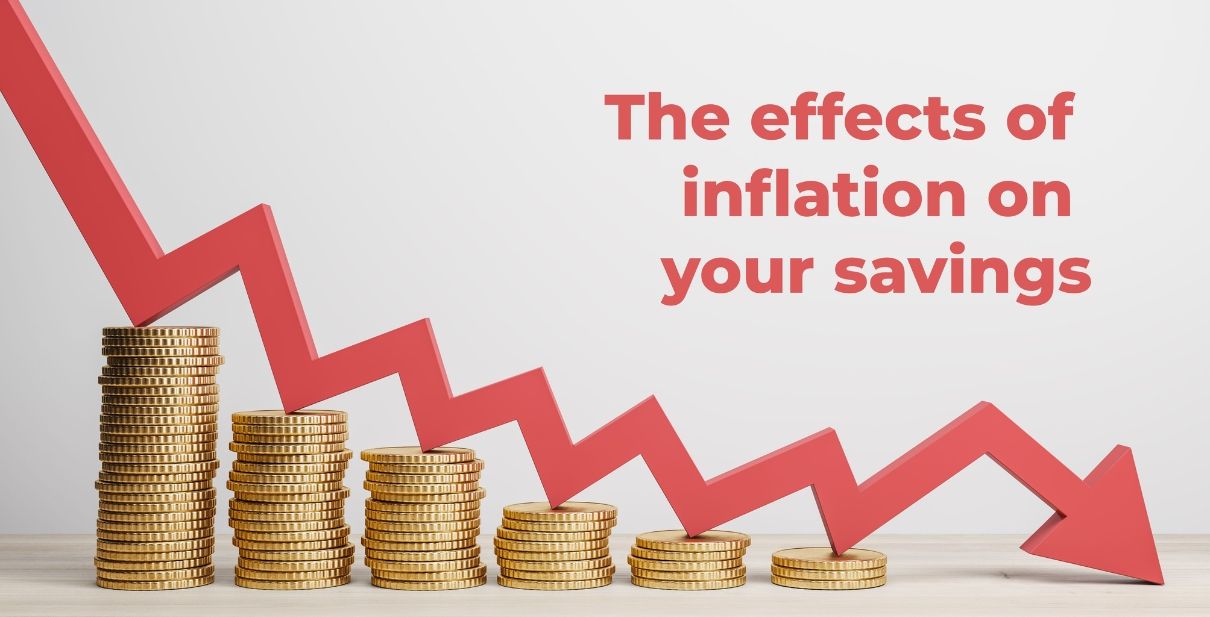
Inflation affects every household. When prices rise, money loses purchasing power. Many people notice this especially when shopping, with energy prices or rent. That is why it is important to understand how inflation and the inflation rate work and which strategies can help protect personal wealth.
Especially for savers, inflation is a decisive factor. Money that stays in an account for years can lose value in real terms. However, those who deal with the topic can take targeted measures to reduce the loss of purchasing power.
What is inflation explained simply
Many people first ask: what is the inflation rate and how is it calculated. Basically, inflation describes the general increase in prices for goods and services within an economy.
A simple example:
- A loaf of bread costs €2 today
- One year later the same bread costs €2.20
- Prices have therefore increased by 10%
This increase in prices is called inflation.
Simply put: inflation explained simply means that money becomes less valuable over time because you can buy less for the same amount.
How inflation arises and why it increases
To understand why inflation exists, several economic factors must be considered. Inflation usually arises from the interaction of supply, demand and monetary policy.
The most important causes include:
- Rising demand
If many people want to buy more products at the same time, prices often rise.
- Higher production costs
If energy, raw materials or wages become more expensive, companies often pass these costs on to consumers.
- Central bank monetary policy
If a lot of money enters the economic cycle, this can also lead to rising prices.
That is why economic experts closely monitor how high the inflation rate currently is in order to recognize economic developments at an early stage.
What is the current inflation rate
Many people are interested in how high the inflation rate is in their country. This indicator is usually calculated annually and expressed as a percentage.
An example of the calculation:
- A basket of typical consumer goods
- Price comparison between two points in time
- Calculation of the percentage price increase
This indicator is called the inflation rate Germany when it is calculated specifically for Germany.
Statistical offices regularly publish data on price developments so that citizens can understand how strongly the purchasing power of their money is affected. In Germany, for example, the Federal Statistical Office regularly publishes data on inflation development.
Why inflation affects your savings
Many people underestimate the effect inflation can have on long-term savings.
Assume:
- You save €10,000 in an account
- The annual inflation is 5%
Then the real purchasing power of this money can decrease significantly within a few years. In this context people speak of rising inflation when price increases continue over a longer period of time.
This does not mean the money disappears – but its purchasing power decreases.
Which inflation rate is considered normal
Economists often discuss which inflation rate is good for an economy.
Many central banks pursue an inflation target of about 2% per year. This so-called inflation target is intended to provide several advantages:
- moderate price stability
- economic growth
- stable investment conditions
Too high inflation can cause economic uncertainty. Negative inflation (deflation) can also be problematic because it slows consumption and investment.
| Inflation rate | Assessment | Economic impact |
| 0% or negative | Deflation | Consumption and investment may decline |
| 1–3% | Normal | Stable economic development |
| 4–7% | Elevated | Loss of purchasing power for savers |
| >7% | High inflation | Economic uncertainty |
Strategies to protect money from inflation
Savers can use different strategies to avoid loss of purchasing power.
1. Diversification of investments
It is advisable to distribute wealth across several asset classes:
- Stocks
- ETFs
- Real estate
- Commodities
- Savings accounts or fixed-term deposits
2. Long-term investments
Historically, real assets such as stocks or real estate have often achieved higher long-term returns than traditional savings products.
3. Regular investing
A monthly savings plan can help balance market fluctuations and build wealth over the long term.
4. Inflation-protected investments
Some government bonds or funds are specifically designed to reduce value loss caused by inflation.
Conclusion
Inflation is a natural part of modern economies. Those who understand what is meant by the term inflation can make better financial decisions.
Savers should regularly check how price increases affect their wealth and develop appropriate strategies. Diversification, long-term investments and a basic understanding of economic relationships can help limit the loss of purchasing power.
FAQ
How is inflation calculated
Inflation is calculated based on a basket of goods. Prices of many typical products are compared and the average price development is determined.
What happens when inflation rises
When prices rise more strongly, money loses purchasing power faster. Consumers can then afford less for the same amount.
What is the real inflation rate
The actual inflation rate depends on which products and services are considered. Official statistics provide average values for the entire economy.
Which inflation rate is good
Many central banks consider inflation of around two percent to be stable and economically reasonable.
Is inflation good or bad
Moderate inflation can support economic growth. However, very high inflation can negatively affect purchasing power and financial stability.